

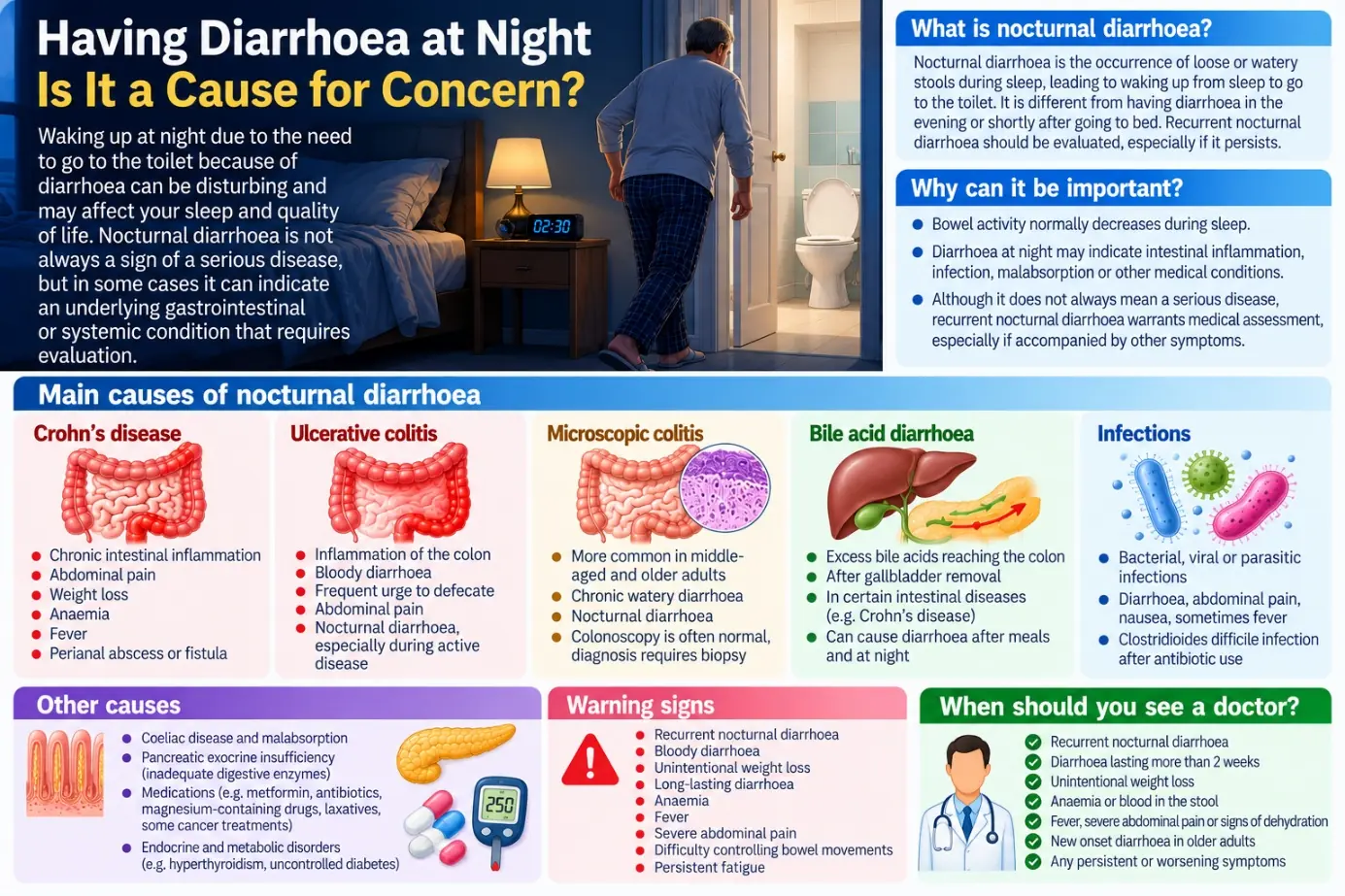
Do you wake from sleep because of diarrhoea? Is your sleep often broken by the need to go to the toilet?
Diarrhoea means the stool is looser than normal, and usually that you go more often.
Diarrhoea during the day is very common. But diarrhoea that wakes you from sleep — especially if it keeps happening — is a symptom that needs to be looked at more carefully.
Diarrhoea at night does not always mean a serious illness. But it can be an early sign of conditions such as bowel inflammation, infection or malabsorption.
What is nocturnal diarrhoea?
Nocturnal diarrhoea means waking during sleep because you need to open your bowels, and passing loose stools.
There is an important distinction here.
Having diarrhoea late in the evening or just before bed is not the same as being woken from sleep by diarrhoea.
Diarrhoea that wakes you from sleep and keeps recurring in particular may call for investigation of certain bowel diseases.
Why does nocturnal diarrhoea matter?
Bowel movements and the urge to go usually decrease during sleep.
So most people do not open their bowels during the night.
But when there is bowel inflammation, excessive fluid secretion or certain malabsorption problems, diarrhoea can continue into the night.
Important: Diarrhoea at night does not on its own make a diagnosis of any particular disease. But especially in long-lasting diarrhoea, it is one of the warning signs that calls for a search for an underlying organic disease.
Digestive Causes of Nocturnal Diarrhoea
1. Crohn’s disease
Crohn’s disease is a chronic inflammatory bowel disease that can affect different parts of the digestive system.
When there is active inflammation in the bowel, diarrhoea can continue at night.
In Crohn’s disease, diarrhoea at night may come with:
- Abdominal pain
- Unintentional weight loss
- Anaemia
- Tiredness
- Fever
- An abscess or fistula around the anus
An assessment for Crohn’s disease may be needed especially when diarrhoea lasts for weeks together with weight loss.
2. Ulcerative colitis
Ulcerative colitis is a disease that causes chronic inflammation of the large bowel.
When the disease is active, bowel movements can become more frequent.
Because the rectum is affected in particular, a sudden urge to go and a feeling of not having emptied fully despite going can develop.
Some patients are woken from sleep by the need to open their bowels.
If diarrhoea at night comes with bloody stools, mucus, abdominal pain and needing the toilet often, investigation for ulcerative colitis may be needed.
In patients already known to have ulcerative colitis, bowel movements at night may call for an assessment of disease activity.
3. Microscopic colitis
Microscopic colitis is one of the causes of chronic watery diarrhoea, seen especially in middle-aged and older people.
In this condition the large bowel often looks normal at colonoscopy.
But the diagnosis can be made by examining biopsies taken from the bowel under the microscope.
Microscopic colitis can cause:
- Long-lasting watery diarrhoea
- Diarrhoea at night
- A sudden urge to go
- Difficulty holding on
- Sometimes abdominal pain
Important: A normal-looking colonoscopy does not rule out microscopic colitis. In suspected cases, bowel biopsies may need to be taken.
4. Bile acid diarrhoea
Bile acids are substances that help digest fats.
Normally they are largely reabsorbed in the small bowel.
In some patients, however, too much bile acid reaches the large bowel.
This increases water secretion and bowel activity and can cause watery diarrhoea.
Bile acid diarrhoea can be seen particularly:
- After gallbladder surgery
- In Crohn’s disease affecting the last part of the small bowel
- After surgery on the ileum
- In some people with chronic diarrhoea where no clear cause is found
Bile acid diarrhoea is mostly noticeable after meals, but some patients also have bowel movements at night.
5. Bowel infections
Bacteria, viruses and some parasites can cause bowel infections.
In these infections diarrhoea can continue by day or by night.
Fever, abdominal pain, nausea and vomiting may come with it.
In diarrhoea that develops after a course of antibiotics, Clostridioides difficile infection should also be considered.
Some infections can be more severe in people whose immune system is suppressed.
6. Coeliac disease and malabsorption
In coeliac disease, the lining of the small bowel is affected and absorption of nutrients can be impaired.
Some patients have chronic diarrhoea, weight loss, bloating and nutritional deficiencies.
In advanced malabsorption, diarrhoea can continue into the night.
But diarrhoea at night is not specific to coeliac disease.
7. Pancreatic enzyme insufficiency
When the pancreas cannot produce enough digestive enzymes, digestion of fat in particular can be impaired.
This can lead to bulky, greasy, foul-smelling stools and weight loss.
In some patients diarrhoea also occurs at night.
This should be considered especially in patients with chronic pancreatitis or a history of pancreatic surgery.
8. Medicine-related diarrhoea
Some medicines can increase bowel movements or affect fluid secretion in the bowel.
For example:
- Metformin
- Medicines containing magnesium
- Some antibiotics
- Laxatives
- Some cancer treatments
can cause diarrhoea.
Medicine-related diarrhoea can also continue at night.
It is important to review the medicines and supplements you take.
How Is Nocturnal Diarrhoea Different from IBS?
Irritable bowel syndrome (IBS) is a disorder of gut–brain interaction with abdominal pain and changes in bowel habit.
People with IBS can have diarrhoea, constipation or both.
But recurrent diarrhoea that wakes a person from sleep is not a typical feature of IBS.
So in patients with diarrhoea at night, it is not right to put the symptoms down to IBS alone.
Organic diseases should be looked for especially if there is blood in the stool, weight loss, anaemia or raised markers of inflammation.
Even so, diarrhoea at night does not by itself completely rule out IBS.
Which Symptoms Matter in Nocturnal Diarrhoea?
| Symptom | Conditions to consider |
|---|---|
| Bloody diarrhoea | Ulcerative colitis, Crohn’s disease, infections and other causes |
| Long-lasting watery diarrhoea | Microscopic colitis, bile acid diarrhoea and other causes |
| Diarrhoea with weight loss | Inflammatory bowel disease, malabsorption |
| Diarrhoea after antibiotics | C. difficile infection and other causes |
| Greasy, bulky stools | Pancreatic enzyme insufficiency, malabsorption |
| Fever and abdominal pain | Bowel infections, active bowel inflammation |
| Diarrhoea with anaemia | Crohn’s disease, coeliac disease and other causes |
This table shows possible causes; it cannot be used to make a definite diagnosis.
How Is the Cause of Nocturnal Diarrhoea Investigated?
First, the doctor looks at how long the diarrhoea has been going on, how many times a day you go, what the stool looks like and what other symptoms come with it.
In particular, the doctor asks whether you are really being woken from sleep by diarrhoea.
The medicines you take, any past operations and your existing conditions are also important.
Where needed, the following tests may be done:
- Full blood count
- CRP and other markers of inflammation
- Faecal calprotectin
- Stool tests for infection
- Blood tests for coeliac disease
- Faecal pancreatic elastase where needed
- Suitable tests for bile acid diarrhoea
- Colonoscopy and bowel biopsies
Not every patient needs all of these tests.
Tests are chosen according to the clinical findings.
What Should Patients with Nocturnal Diarrhoea Do?
First of all, it is important to find the cause of the diarrhoea.
Meanwhile, drink enough fluid and prevent fluid loss.
With frequent watery stools in particular, water and salts (electrolytes) can be lost.
Where needed, suitable oral rehydration solutions can be used.
Foods that make the symptoms worse can be limited for a while.
But long-term and unnecessary dietary restrictions should be avoided.
Patients with bloody diarrhoea, fever or severe abdominal pain should not take anti-diarrhoea medicine without asking a doctor.
When Should You See a Doctor?
A gastroenterology assessment is needed especially in the following situations:
- Diarrhoea at night that keeps recurring
- Diarrhoea that lasts a long time
- Unintentional weight loss
- Anaemia
- Blood in the stool
- Fever
- Marked tiredness
- Difficulty holding on
Severe abdominal pain, marked dehydration, fainting, confusion or heavy bloody diarrhoea need urgent assessment.
Frequently Asked Questions
Is diarrhoea at night a sign of cancer?
Diarrhoea at night on its own is not a sign of cancer.
But diarrhoea that is new, especially in older age, lasts a long time, or comes with weight loss or anaemia needs to be investigated.
Can diarrhoea at night be caused by IBS?
Bowel habits can change in IBS. But recurrent diarrhoea that wakes you from sleep is not typical of IBS.
So it is important to consider other conditions.
My colonoscopy was normal but I still have diarrhoea at night. Why?
Causes such as microscopic colitis, bile acid diarrhoea, some malabsorption problems or medicine-related diarrhoea may be involved.
In microscopic colitis in particular, the diagnosis can be made by biopsy even though the bowel looks normal.
Do I definitely need a colonoscopy for diarrhoea at night?
No. The decision about colonoscopy depends on your age, symptoms, blood and stool tests and other findings.
Can diarrhoea at night go away on its own?
In some short-lived bowel infections, diarrhoea can settle on its own.
But diarrhoea at night that keeps recurring or lasts a long time should be investigated.
Conclusion
Diarrhoea that wakes you from sleep, especially if it keeps happening, is a symptom that should be taken seriously.
Crohn’s disease, ulcerative colitis, microscopic colitis, bile acid diarrhoea, bowel infections and some malabsorption problems can cause diarrhoea at night.
Remember: diarrhoea at night does not always mean a serious illness. But diarrhoea that wakes you from sleep, lasts a long time or comes with other warning signs should not be put down to irritable bowel syndrome alone.
This article is for general patient information. It does not replace an assessment by a doctor for diagnosis and treatment.
Sources
- Prof. Ali Tüzün İnce, MD