

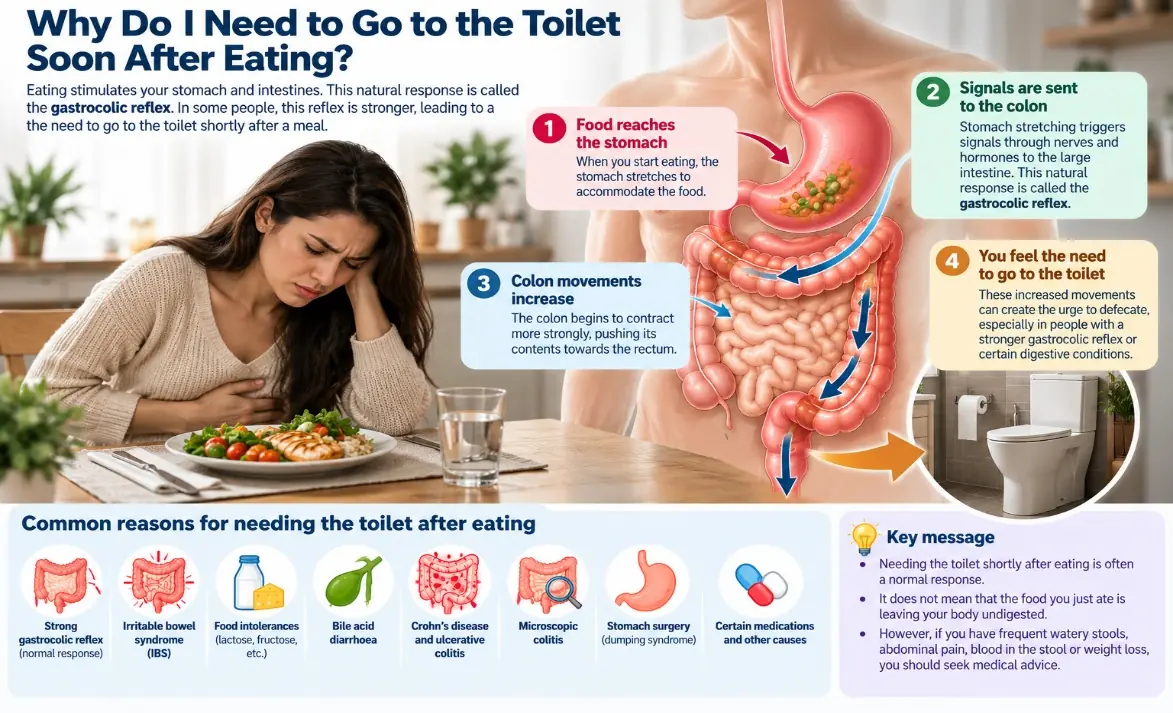
Do you feel the need to go to the toilet shortly after eating? Does the urge to open your bowels come especially after breakfast, or even before you have finished your meal?
This happens to many people and is not always a sign of illness. But if it comes with a fear of not reaching the toilet in time, frequent bowel movements, abdominal pain or diarrhoea, the cause may need to be looked into.
One of the most important reasons for needing the toilet after a meal is a natural bowel response called the gastrocolic reflex.
What is the gastrocolic reflex?
The gastrocolic reflex is a natural mechanism that increases the movements of the large bowel (colon) when food enters the stomach.
When we start to eat, the stomach stretches. The digestive system responds to this through nerves and hormones. As a result, contractions in the large bowel increase and the bowel contents can move on towards the rectum.
In some people these movements create the urge to open the bowels.
The important point is this: going to the toilet straight after eating does not mean that the food you have just eaten is leaving your body undigested.
What is passed is made up of the remains of food eaten earlier, which has already been through digestion.
The gastrocolic reflex can be more noticeable in the morning and after meals.
Why is the gastrocolic reflex stronger in some people?
Everyone has this reflex, but its strength varies from person to person.
Some people do not notice any bowel activity after eating, while others may feel the need to go within a few minutes.
Things that can strengthen the reflex include large meals, fatty food, coffee and, in some people, stress.
Breakfast in particular can wake up the large bowel, which has been less active through the night.
So going to the toilet after breakfast is usually a normal physiological event.
But if the urge comes very suddenly, if you struggle to reach the toilet in time, or if it affects your daily life, other causes should be looked for as well.
Causes of Needing the Toilet Right After Eating
1. Irritable bowel syndrome (IBS)
In irritable bowel syndrome, the movements of the bowel and the way sensations from the bowel are perceived can change.
The urge to open the bowels after meals can be especially marked in people with diarrhoea-predominant IBS.
In some people with IBS the gastrocolic response is stronger. The bowel can also be more sensitive to normal contractions.
So rumbling, cramps, bloating and a sudden urge to go may appear after eating.
Some patients may need the toilet even while they are still eating.
In IBS, abdominal pain is usually related to opening the bowels, and changes may be seen in how often you go or in what the stool looks like.
But not every case of needing the toilet after meals means IBS.
Other conditions need to be looked for, especially if there is bloody stool, unexplained weight loss, anaemia or diarrhoea that wakes you from sleep.
2. Food intolerances
Some people get abdominal pain, wind, bloating and diarrhoea after eating certain foods.
One of the best-known examples is lactose intolerance.
Lactose is a natural sugar found in milk and dairy products. When it is not digested well enough in the small bowel, it can draw water into the bowel and be broken down by bacteria in the large bowel, producing gas.
In the same way, fructose found in some fruits, or certain sugar alcohols, can make bowel symptoms worse in sensitive people.
But there is an important distinction here:
Symptoms caused by poor digestion of lactose or other carbohydrates take time to develop. An urge to go that starts a few minutes after eating usually does not come from the food you have just eaten reaching the large bowel.
In that case the gastrocolic reflex may also be playing a part.
3. Bile acid diarrhoea
Bile acids are substances that help digest fats.
Normally they are largely reabsorbed in the small bowel. In some people, however, too much bile acid reaches the large bowel, which can increase water secretion and bowel activity there.
This can cause watery stools, a sudden need to go and sometimes difficulty holding on.
Bile acid diarrhoea can be seen particularly:
- After gallbladder surgery
- In Crohn’s disease affecting the last part of the small bowel
- After surgery on the ileum
- In some people with no obvious bowel disease
Bile acid diarrhoea is sometimes mistaken for IBS.
This possibility should be considered especially when watery diarrhoea keeps coming back after meals.
4. Crohn’s disease and ulcerative colitis
Crohn’s disease and ulcerative colitis are conditions that cause long-term (chronic) inflammation of the bowel.
In these conditions, bowel movements and the ability to hold on can be affected.
With active inflammation of the large bowel in particular, bowel movements can become more frequent and a sudden urge to go can develop.
In ulcerative colitis, inflammation of the rectum can cause a frequent urge to go, and a feeling that the bowel has not fully emptied even after going.
The increased bowel activity after meals can make these symptoms more noticeable.
If there is blood or mucus in the stool, abdominal pain, weight loss or long-lasting diarrhoea, an assessment for inflammatory bowel disease may be needed.
5. Microscopic colitis
Microscopic colitis is one of the causes of chronic watery diarrhoea, seen especially in middle-aged and older people.
In this condition the large bowel may look normal at colonoscopy.
The diagnosis is made by examining biopsies taken during colonoscopy under the microscope.
Patients may have frequent watery stools, a sudden need to go and sometimes diarrhoea at night.
Microscopic colitis should be kept in mind especially in people with long-lasting watery diarrhoea.
6. Stomach surgery and dumping syndrome
After some operations on the stomach and oesophagus, food can pass from the stomach into the small bowel more quickly.
This is called dumping syndrome.
In early dumping syndrome in particular, abdominal pain, bloating, diarrhoea, palpitations, sweating or weakness can appear shortly after eating.
In these patients the after-meal symptoms are not caused by the gastrocolic reflex alone. Changes in stomach emptying and fluid shifts in the bowel also play a part.
This possibility should be considered especially in people who have had weight-loss (bariatric) surgery or other stomach operations.
7. Medicines and other causes
Some medicines can increase bowel activity or cause diarrhoea.
For example, metformin, some products containing magnesium, antibiotics and laxatives can make some people go more often.
Apart from these, bowel infections, coeliac disease, a shortage of digestive enzymes from the pancreas and an overactive thyroid gland can also cause frequent bowel movements.
Not every one of these conditions has to strengthen the gastrocolic reflex directly. But they may lie behind bowel symptoms that are noticed after meals.
How Can a Normal Gastrocolic Reflex Be Told Apart from Bowel Movements Caused by Disease?
| Feature | Normal gastrocolic reflex | Situation that needs investigating |
|---|---|---|
| When you go | Usually after breakfast or a meal | After every meal, very often, or at night |
| Stool consistency | Usually formed | Frequent watery stools |
| Abdominal pain | None or mild | Recurrent or severe |
| The urge to go | Can be controlled | Sudden, hard to reach the toilet in time |
| Weight loss | Not expected | May be present |
| Blood in the stool | Absent | May be present |
| Daily life | Usually unaffected | Work, school or social life may be affected |
This table is a general comparison. It does not make a diagnosis on its own.
When Should You See a Doctor?
Going to the toilet after meals may not be a sign of illness on its own.
But a gastroenterology assessment is important in the following situations:
- Symptoms that are new and persistent
- Diarrhoea that lasts a long time or keeps getting worse
- Blood in the stool
- Unintentional weight loss
- Diarrhoea that wakes you from sleep
- Anaemia or marked tiredness
- Severe or constant abdominal pain
- Not reaching the toilet in time, or leaking stool
- A family history of bowel cancer or inflammatory bowel disease
Severe abdominal pain, heavy bleeding, fainting or signs of serious fluid loss may need urgent assessment.
Which Tests Are Done to Find the Cause?
Different investigations may be planned depending on your symptoms and the examination findings.
First, the doctor looks at when the problem began, the consistency of the stool, which foods make it worse, whether there is diarrhoea at night, and which medicines you take.
Where needed, a full blood count, coeliac tests, faecal calprotectin and tests for infection may be done.
If bile acid diarrhoea, lactose intolerance or another malabsorption problem is suspected, tests for these can be planned.
Colonoscopy is not needed for everyone. But it may be done if there are warning signs, if screening is due, or if certain conditions are suspected.
Especially when microscopic colitis is suspected, biopsies may need to be taken even if the bowel looks normal.
How Can the Need for the Toilet After Eating Be Reduced?
Treatment is planned according to the cause.
If no underlying disease is found, some changes to diet and lifestyle may help.
It may help to eat smaller meals instead of large ones, cut down on very fatty food, and notice whether coffee makes the symptoms worse.
Eating slowly and at regular times can also help some people.
To find out which foods make the symptoms worse, you can keep a short food and bowel diary.
But it is not right to cut lots of foods out of your diet unnecessarily.
If IBS, lactose intolerance, bile acid diarrhoea or another condition is found, treatment is adjusted accordingly.
Important: In long-lasting diarrhoea of unknown cause, the underlying reason should be investigated first, rather than taking anti-diarrhoea medicine all the time.
Frequently Asked Questions
Is it normal to need the toilet five minutes after eating?
Yes, it can be normal for some people. The gastrocolic reflex can increase large-bowel activity shortly after you start eating.
But if it comes with constant watery diarrhoea, severe pain or sudden urgency where you cannot reach the toilet in time, it needs to be assessed.
Does needing the toilet straight after eating mean my food was not digested?
No. Food you have just eaten is not expected to pass through the whole digestive system within a few minutes.
Eating can trigger the natural movements that push along stool that was already in the large bowel.
Is needing the toilet after every meal a sign of IBS?
It can be, but on its own it does not make a diagnosis of IBS.
The diagnosis of IBS is based on recurrent abdominal pain together with changes in bowel habit.
Why do I go to the toilet more often after breakfast?
Large-bowel activity naturally increases in the morning and after meals.
So feeling the need to go after breakfast is common and usually normal.
Does going to the toilet after meals make you lose weight?
Bowel movements caused by a normal gastrocolic reflex do not cause weight loss on their own.
But frequent bowel movements due to chronic diarrhoea, malabsorption or bowel inflammation can come with weight loss.
Do I need to stop myself going to the toilet after meals altogether?
No. A normal gastrocolic reflex does not need to be suppressed.
The aim of treatment is not to get rid of your natural bowel pattern, but to treat any disease that is present and to reduce symptoms that spoil your quality of life.
Conclusion
Needing the toilet straight after a meal usually comes from a natural digestive response called the gastrocolic reflex.
But a stronger reflex, or diarrhoea after meals, can be linked to certain conditions.
In particular, irritable bowel syndrome, bile acid diarrhoea, food intolerances, inflammatory bowel disease and microscopic colitis should be considered.
Remember: feeling the need to open your bowels after eating is not always a disease. But if constant diarrhoea, abdominal pain, blood in the stool or weight loss come with it, the cause should be looked into.
This article is for general patient information. It does not replace an assessment by a doctor for diagnosis and treatment.
Sources
- Prof. Ali Tüzün İnce, MD