

Professor Ali Tüzün İnce, MD
Digestive System Diseases, Endoscopic Procedures
Experience in Gastroenterology, Information You Can Trust
Accurate, current and understandable information about diseases of the digestive system and endoscopic procedures.
This site was prepared in the light of many years of clinical and academic experience, to help patients better understand their complaints, their test results and the treatment options open to them.
Prof. Ali Tüzün İnce, MD continues his academic and clinical work at the Department of Gastroenterology, Bezmialem Vakıf University.
In the light of that experience, the site sets out to guide patients who have a digestive complaint, who need a gastroenterology assessment, or who are to have an endoscopy or a colonoscopy — as well as those who need an advanced endoscopic procedure or a second opinion.
What is troubling you?
Most people search for what they feel rather than for a diagnosis. Each complaint below leads to the pages that discuss it.
- Abdominal pain
- Irritable Bowel Syndrome (IBS)Gallstones: What Do They Mean?Diverticulosis, Diverticulitis and Diverticular BleedingCrohn's DiseaseUlcerative Colitis
- Bloating
- Gas and BloatingIrritable Bowel Syndrome (IBS)Coeliac DiseaseDelayed Gastric Emptying (Gastroparesis)Ascites (Fluid in the Abdomen)
Information about digestive system conditions
If you know where your complaint is coming from, start there. Every organ on the drawing leads to the pages written about it.
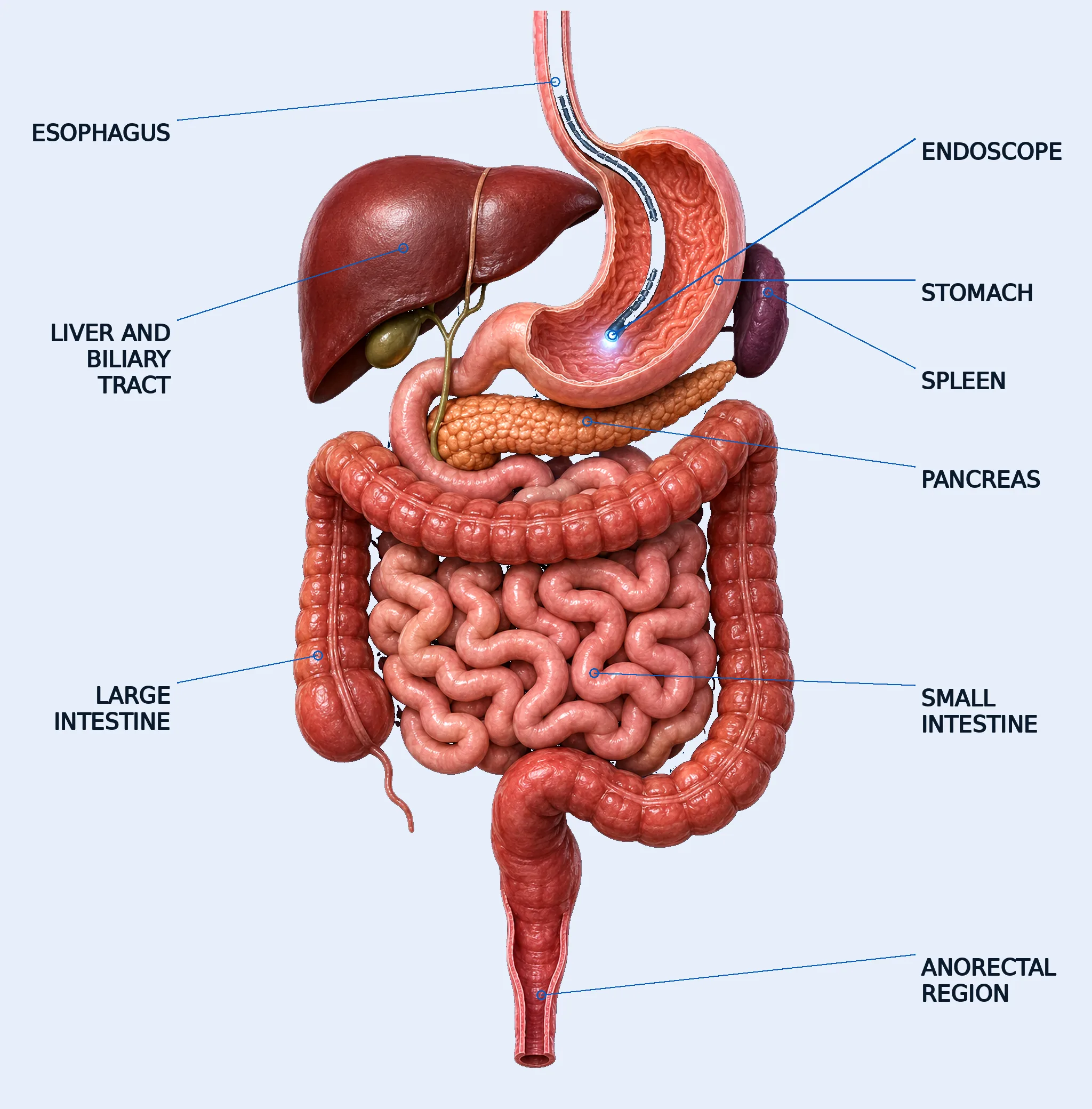
Procedures
Endoscopic procedures
Preparation, the procedure itself, and aftercare — explained step by step for each examination.
Gastroscopy
Gastroscopy is the procedure of examining the upper digestive tract with a long, tube-shaped, flexible instrument that has its own light source and a camera at its tip.
Colonoscopy and Preparing for It
Colonoscopy is the examination of the inner surface of the large bowel with a thin, flexible instrument carrying a camera, allowing biopsies and the removal of polyps where these are needed.
Polypectomy (Removing a Polyp)
Polypectomy is the removal of polyps in the stomach or bowel during endoscopy or colonoscopy; no incision is made, and removing suitable polyps can prevent bowel cancer.
What people ask most about endoscopy and colonoscopy
The four asked most often, answered from the procedure pages on this site.
Is a colonoscopy painful?
Sedation is usually given. Afterwards there can be bloating and pain from the air used during the examination, and that lasts until the gas passes.
Colonoscopy and Preparing for ItHow long does an endoscopy take?
A gastroscopy takes 5–15 minutes and a colonoscopy 20–45 minutes, not counting the preparation and the rest afterwards.
GastroscopyIs taking a biopsy dangerous?
Samples are taken from wherever the physician judges they are needed. In his own words the procedure is straightforward and painless.
When can I eat afterwards?
If a sedative was given, nothing by mouth for three to four hours. After a colonoscopy you can return to your usual diet once you have rested three or four hours. Avoid gas-forming foods for the rest of that day.
When should you see a gastroenterologist?
The digestive system is made up of the mouth, the oesophagus, the stomach, the gallbladder, the liver, the pancreas, the small and large intestines, the rectum and the anus. Diseases of these organs fall within the field of gastroenterology. Some complaints to do with the digestive system that look simple to you can sometimes be the first signs of very serious disease. If you have:
- Abdominal pain with no explanation
- Weight loss
- Unexplained blood in the stool
- Changes in the calibre and shape of the stool
- Haemorrhoid complaints that keep getting worse
- A history of bowel cancer, or of a malignant polyp (adenoma), in a member of your family
- Unexplained laboratory findings (anaemia, or a rise in the sedimentation rate, CRP, CEA and AFP levels)
- Diarrhoea lasting more than twenty days
- Changes that have begun in your bowel habit (constipation starting for no reason, alternating periods of diarrhoea and constipation)
- Increasing difficulty in swallowing, together with weight loss
- Stomach pain, vomiting and blood in the vomit that will not pass and does not respond to medical treatment
- Yellowing of the eyes and skin, weakness, tiredness, darkening of the urine, persistent itching
“Remember: ignoring it does not only cost you time”
Urgent symptomsImage archive
Endoscopic atlas
Photographs of findings as they appear at endoscopy, with the physician’s notes. Every entry is made of real patient images of that finding.
- A Normal Gastroscopy
- Amoebic Colitis
- Anal Fissure
- Angiodysplasia
- Barrett's Oesophagitis
- Bezoar in the Stomach (Foreign Body)
- Bleeding from the Stomach
- Brunneroma
106 images
Academic work
For his academic work and scientific publications, see the curriculum vitae.
- 2026 Is it possible to predict hemorrhage after endoscopic papillectomy?
- 2026 The efficacy of multiple stenting from minor papilla in achieving sustained remission of recurrent acute pancreatitis
- 2025 EUS-Guided Pancreatic Duct Drainage: On which patients, how to perform it? Is it as complicated as thought?