

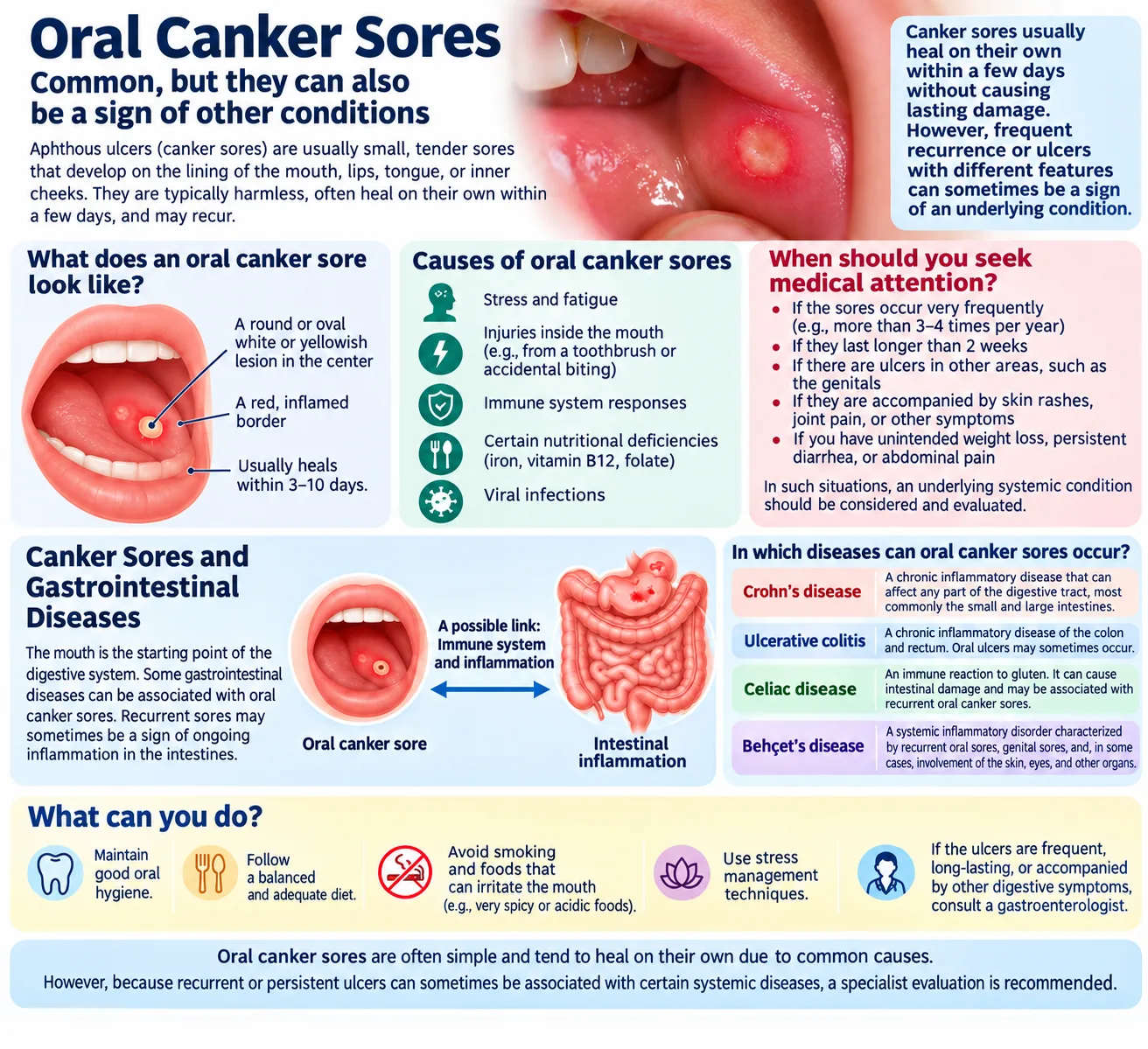
Recurrent sores in the mouth are sometimes not just a problem of the mouth. Ulcers that come back often or heal slowly can be an early sign of certain bowel diseases and nutritional deficiencies.
What is a mouth ulcer?
A mouth ulcer (aphthous ulcer) is a painful, shallow sore, usually round or oval, in the delicate lining of the mouth.
It is usually whitish or yellowish in the middle and red around the edge. It can appear on the sides of the tongue, the inside of the lips and cheeks, the floor of the mouth or the soft palate.
Mouth ulcers can hurt when you eat, talk or brush your teeth. Acidic, spicy and hot foods in particular can make the pain worse.
Mouth ulcers are not contagious. Unlike cold sores, they are not caused by the herpes virus.
Why do mouth ulcers happen?
There may be no single cause. Genetic predisposition, the immune system’s response and environmental factors can all play a part together.
Things that can make mouth ulcers more likely include:
- Stress and lack of sleep
- Accidentally biting the cheek or tongue
- Brushing too hard and other injuries inside the mouth
- Iron, vitamin B12 and folate deficiency
- Personal sensitivity to certain foods
- Hormonal changes
- Some medicines
- Diseases related to the immune system
- Crohn’s disease, coeliac disease and some other systemic diseases
In most cases of mouth ulcers there is no serious underlying disease. But mouth ulcers that keep coming back may need their cause investigated.
Types of mouth ulcer
1. Minor ulcers
This is the most common type.
They are usually smaller than 1 cm. Most heal without a scar within 7–14 days.
2. Major ulcers
These are larger, deeper and more painful sores.
They can take weeks to heal. Sometimes they leave a scar.
3. Herpetiform ulcers
These appear as many small sores close together.
Despite the name, they have nothing to do with the herpes virus.
The Link Between Mouth Ulcers and Digestive Diseases
The mouth and the bowel are different parts of the digestive system. Some diseases can affect both the bowel and the tissues inside the mouth.
So a gastroenterology assessment becomes important especially when recurrent mouth ulcers come with abdominal pain, diarrhoea, weight loss, anaemia or nutritional deficiencies.
1. Crohn’s disease and mouth ulcers
Crohn’s disease is a chronic inflammatory bowel disease that can affect any part of the digestive system from the mouth to the anus.
People with Crohn’s disease can get recurrent ulcer-like sores in the mouth.
In some patients, the mouth findings can appear before the bowel symptoms.
In Crohn’s disease, not only ulcers but also swelling of the lips, thickening of the lining of the mouth and some other characteristic changes can be seen.
An assessment for Crohn’s disease may be needed if mouth ulcers come with:
- Long-lasting or recurrent diarrhoea
- Abdominal pain
- Unintentional weight loss
- Anaemia
- Blood in the stool
- An abscess or fistula around the anus
- Unexplained fever and tiredness
In Crohn’s disease, mouth ulcers can be linked to the immune changes caused by the disease, or to deficiencies of nutrients such as iron, vitamin B12 and folate.
Important: Having mouth ulcers does not on its own make a diagnosis of Crohn’s disease.
2. Ulcerative colitis and mouth ulcers
Ulcerative colitis is a chronic inflammatory bowel disease affecting the large bowel.
As in Crohn’s disease, symptoms outside the bowel can be seen in ulcerative colitis too. One of these is sores in the mouth.
Patients with ulcerative colitis can develop recurrent mouth ulcers. But mouth ulcers are not specific to Crohn’s disease, and they do not on their own support a diagnosis of ulcerative colitis either.
In some patients the mouth sores increase when the disease is active. Even so, mouth ulcers do not always run in parallel with how severe the bowel disease is.
In ulcerative colitis, a rare but striking involvement of the mouth called pyostomatitis vegetans can also develop, with many small inflamed blisters and shallow sores inside the mouth.
Mouth sores that appear together with bloody diarrhoea, more frequent bowel movements and abdominal pain in particular should be assessed.
3. Coeliac disease and recurrent mouth ulcers
Coeliac disease is an immune-mediated disease of the small bowel triggered by eating gluten in people with a genetic predisposition.
In coeliac disease the lining of the small bowel can be damaged and absorption of certain nutrients can be impaired.
Recurrent mouth ulcers can be one of the symptoms of coeliac disease outside the bowel.
In some people mouth ulcers can appear without obvious diarrhoea or abdominal pain.
In coeliac disease, the following can contribute to mouth ulcers:
- Iron deficiency
- Folate deficiency
- Vitamin B12 deficiency
- Immune-related mechanisms
It may be appropriate to test for coeliac disease if recurrent mouth ulcers come with iron-deficiency anaemia, bloating, chronic diarrhoea, weight loss or a family history of coeliac disease.
Blood tests such as total IgA and tissue transglutaminase IgA antibody are usually used to test for coeliac disease. Where needed, an endoscopy and small-bowel biopsy may be done.
Important: Starting a gluten-free diet before coeliac disease has been tested for can make the diagnostic tests less reliable.
4. Behçet’s disease and mouth ulcers
Behçet’s disease is one of the important causes of recurrent mouth sores.
In this disease mouth ulcers often keep coming back, and sometimes there are many of them.
As well as mouth sores, there can be genital sores, eye inflammation, skin findings and joint complaints.
Behçet’s disease can also affect the digestive system in some patients.
When the bowel is involved, abdominal pain, diarrhoea and bowel ulcers can develop.
Intestinal Behçet’s disease and Crohn’s disease can sometimes look alike, so telling them apart is important.
If mouth ulcers come with genital ulcers, or with pain, redness or changes in vision in the eye, Behçet’s disease must be considered. Changes in vision need urgent assessment.
5. Vitamin and mineral deficiencies
Nutritional deficiencies have an important place in the investigation of recurrent mouth ulcers.
The following deficiencies in particular can be linked with mouth ulcers:
Iron deficiency: can cause anaemia, tiredness and changes in the lining of the mouth.
Vitamin B12 deficiency: can be linked with a sore tongue, a smooth tongue surface, a burning mouth and ulcer-like sores.
Folate deficiency: can affect renewal of the lining of the mouth and contribute to ulcers.
Zinc deficiency: can affect healing of the lining of the mouth in some patients.
These deficiencies can come from poor nutrition, but they can also develop as a result of coeliac disease, Crohn’s disease or some malabsorption disorders.
Rather than taking vitamins or minerals at random before any deficiency has been found, it is better to assess the situation with the appropriate blood tests.
6. Other digestive diseases
Recurrent mouth sores are sometimes linked to other digestive problems as well.
For example, vitamin B12 and iron deficiencies due to stomach or small-bowel disease can lead to changes in the lining of the mouth.
Nutritional deficiencies after stomach or bowel operations can also affect the health of the mouth.
But it is not right to link every mouth sore to a stomach or bowel disease.
In particular, it has not been clearly shown that stomach acid, reflux or Helicobacter pylori infection directly cause recurrent mouth ulcers. So it is not appropriate to start treatment for these conditions just because there are mouth ulcers.
When Should Mouth Ulcers Be Taken Seriously?
You should see a doctor in the following situations:
- A mouth sore that lasts longer than two weeks or shows no sign of healing
- Sores that come back very often
- Large, deep or very painful sores
- Sores that make eating and drinking difficult
- Long-lasting diarrhoea or abdominal pain together with the ulcers
- Unexplained weight loss or anaemia
- Sores developing in the genital area
- Redness, pain or changes in vision in the eye
- A lump in the neck, hardening in the mouth, or a sore that bleeds easily
Mouth sores that do not heal, have hard edges or are on one side only in particular need to be told apart from other diseases. Not every mouth sore is an aphthous ulcer.
How Is the Cause of Mouth Ulcers Investigated?
The doctor first looks at how often the sores appear, how long they last and what other symptoms come with them.
Where considered necessary, the following tests may be done:
- Full blood count
- Iron and ferritin levels
- Vitamin B12 and folate levels
- Zinc level where needed
- Blood tests for coeliac disease
- Faecal calprotectin when bowel inflammation is suspected
- Colonoscopy and/or gastroscopy depending on the clinical findings
Not every patient with mouth ulcers needs all of these tests.
Tests are chosen according to the patient’s symptoms and examination findings.
How Are Mouth Ulcers Treated?
Treatment depends on how often the ulcers come, their size, how painful they are and the underlying cause.
Measures you can take at home
You can keep away from hard, very hot, acidic or spicy foods that irritate the inside of the mouth.
Use a soft toothbrush and take care with oral hygiene.
Mouthwashes containing alcohol can increase irritation in some people.
Drinking enough fluid and eating a balanced diet are important.
Medicines
To reduce pain and help healing, protective or pain-relieving products applied inside the mouth can be used on a doctor’s advice.
Local treatments containing corticosteroids can be helpful for recurrent ulcers.
Very frequent or severe ulcers may need different treatments.
Antibiotics, antiviral medicines and antifungal medicines are not routine treatments for ordinary mouth ulcers.
Treating the underlying disease
If the ulcers turn out to be linked to Crohn’s disease, coeliac disease or a nutritional deficiency, treating the main disease becomes important.
For example, in coeliac disease a proper gluten-free diet, correcting nutritional deficiencies and bringing the disease under control can help reduce mouth sores.
In Crohn’s disease, bringing the bowel inflammation under control can also improve the mouth findings in some patients.
Frequently Asked Questions
Is a mouth ulcer a sign of cancer?
Typical recurrent ulcers that heal within a short time are generally not linked with cancer. But mouth sores that last more than two weeks, do not heal or become hard must be examined.
Should everyone with mouth ulcers have a colonoscopy?
No. Mouth ulcers alone do not call for a colonoscopy. If there is abdominal pain, chronic diarrhoea, blood in the stool, weight loss, anaemia or other warning signs, a gastroenterology investigation may be planned.
Can mouth ulcers be the only sign of coeliac disease?
Yes. Some people with coeliac disease have recurrent mouth ulcers without obvious digestive symptoms. But not every case of recurrent mouth ulcers means coeliac disease.
Can mouth ulcers be the first sign of Crohn’s disease?
Yes. In some patients the mouth findings appear before the bowel symptoms. Even so, because mouth ulcers can have many different causes, Crohn’s disease cannot be diagnosed from this finding alone.
Are mouth ulcers contagious?
No. Recurrent aphthous stomatitis is not a contagious disease.
Conclusion
Mouth ulcers are usually common, harmless sores that heal on their own.
But ulcers that come back often, are large or heal slowly in particular can be linked to certain systemic diseases.
Crohn’s disease, ulcerative colitis, coeliac disease, Behçet’s disease and nutritional deficiencies are the conditions that should be assessed in this respect.
If mouth sores come with long-lasting diarrhoea, abdominal pain, weight loss or anaemia, it is advisable to see a gastroenterologist.
This article is for general information. It does not replace an assessment by a doctor for diagnosis and treatment.
Sources
- Prof. Ali Tüzün İnce, MD