

Do you often feel the need to belch during the day? Does your belching get worse after meals, while you are talking, or when you are stressed?
Belching is the release of air from the digestive system through the mouth. Belching now and then, especially after meals, is normal.
But if belching happens very often, affects your daily life, or comes with other symptoms, the cause may need to be looked into.
Constant belching does not always come from a stomach disease. In some people, air-swallowing habits, the way the oesophagus works, or behavioural mechanisms play an important part.
Why does belching happen?
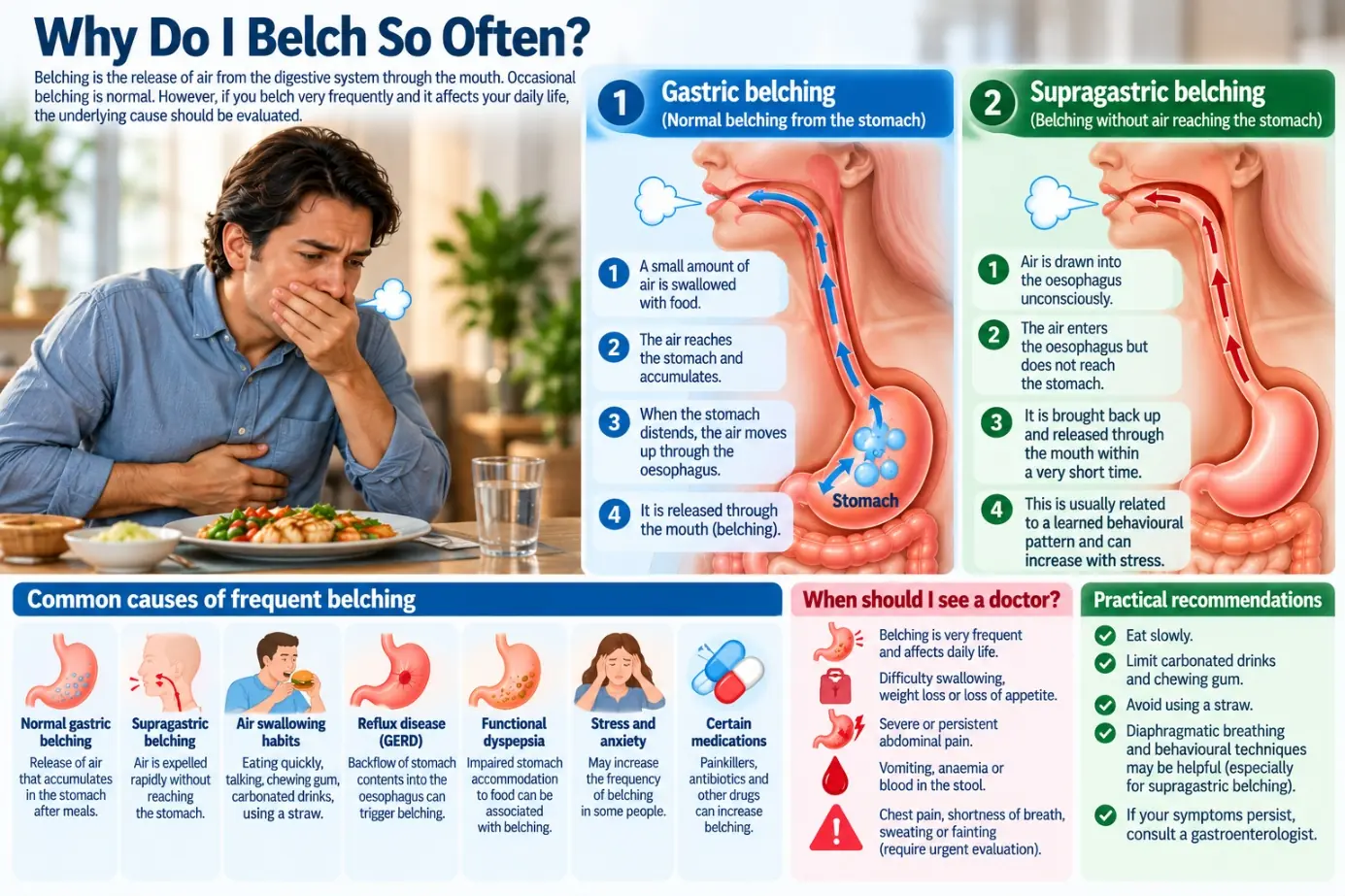
We swallow some air without noticing while eating, drinking water or talking.
Part of this air reaches the stomach. Air that collects in the stomach can travel back up the oesophagus through certain reflexes and leave through the mouth.
This is normal stomach belching.
But not all belching happens through the same mechanism.
Medically, there are two main types of belching:
- Gastric belching (belching from the stomach)
- Supragastric belching (belching in which the air never reaches the stomach)
This distinction matters particularly for people who complain of constant belching.
1. What is gastric belching?
Gastric belching is the release through the mouth of air from the stomach, passing up through the oesophagus.
It is a normal function of the digestive system.
Large meals, eating quickly, fizzy drinks or swallowing a lot of air while eating can all increase stomach belching.
Gastric belching usually happens after meals.
Belching now and then is not a sign of illness.
2. What is supragastric belching?
Supragastric belching is one of the important causes of frequent, repeated belching.
Here, air is drawn from the mouth or throat into the oesophagus and pushed back out quickly before it reaches the stomach.
In other words, the air released during belching often does not come from the stomach at all.
So it is not right to explain supragastric belching simply as too much gas in the stomach.
In some people supragastric belching can become a learned behaviour without their being aware of it.
It can get worse during stressful periods, while talking, or when the person’s attention is focused on the belching.
On the other hand, it can ease when attention turns to something else. Supragastric belching usually does not happen during sleep.
Important: Supragastric belching should not be seen as something the person does on purpose or can easily control. It is a learned behavioural mechanism that can be changed with the right methods.
3. Can constant belching be a sign of reflux?
Yes. Belching can increase in some people with gastro-oesophageal reflux disease.
But the relationship between belching and reflux is not always the same.
In some patients, reflux symptoms can trigger belching.
In others, frequent supragastric belching can make it easier for stomach contents to flow back into the oesophagus, increasing reflux symptoms.
So belching and reflux can influence each other.
The possibility of supragastric belching should be considered especially in patients whose belching continues despite reflux treatment.
Not every case of belching should be assumed to come from stomach acid.
For detailed information on the causes, diagnosis and treatment of reflux disease, see the gastro-oesophageal reflux disease page on our website.
4. What is air swallowing (aerophagia)?
Aerophagia means swallowing more air than normal.
Eating quickly, talking while eating, chewing gum or certain habits can increase air swallowing.
Some of the swallowed air may be released by belching. Air that moves on into the bowel can contribute to bloating and wind.
But aerophagia and supragastric belching are not the same thing.
In aerophagia the air really can reach the stomach and bowel, whereas in supragastric belching the air comes back out before it reaches the stomach.
This distinction can change the treatment approach.
5. Functional dyspepsia and belching
Functional dyspepsia is a digestive disorder with discomfort in the upper abdomen, early fullness and feeling over-full after meals.
Belching can also be seen in these patients.
But belching alone does not make a diagnosis of functional dyspepsia.
Functional dyspepsia may be considered especially when belching comes together with early fullness, feeling over-full after meals and upper abdominal discomfort.
6. Do gastritis and Helicobacter pylori cause belching?
Gastritis or Helicobacter pylori infection is often suspected in people who belch a lot.
But constant belching is not a symptom specific to these conditions.
If someone with Helicobacter pylori infection belches, this does not necessarily mean the belching is caused by the bacterium.
Likewise, finding gastritis at endoscopy may not by itself explain the belching.
So it is not appropriate to take antibiotics or stomach medicines unnecessarily just because of belching.
7. Habits that can increase belching
Some everyday habits can make you belch more often.
These include eating quickly, fizzy drinks, chewing gum, drinking through a straw and swallowing a lot of air while eating.
Large meals and, in some people, smoking can also make the symptoms worse.
Changing these habits can be helpful especially in patients with prominent gastric belching.
The Difference Between Normal Belching and a Belching Disorder
| Feature | Normal gastric belching | Supragastric belching |
|---|---|---|
| Source of the air | Stomach | Mouth and throat |
| Does the air reach the stomach? | Yes | No |
| When does it happen? | Especially after meals | Can repeat frequently through the day |
| Link with stress | Variable | Marked in some patients |
| During sleep | May occur | Usually does not occur |
| Treatment approach | Adjusting diet and habits | Behavioural therapy, diaphragmatic breathing and suitable rehabilitation |
This table is a general comparison. A definite diagnosis may need a clinical assessment.
How Is Constant Belching Diagnosed?
Diagnosis starts with a detailed look at the patient’s symptoms.
The doctor asks how the belching relates to meals, how often it happens during the day, whether it occurs during sleep, and what other symptoms come with it.
In most patients a careful history and examination give important information.
Some patients may need further tests for gastro-oesophageal reflux disease or another digestive problem.
24-hour pH-impedance monitoring
This is one of the important methods used to tell supragastric belching apart from reflux.
The test helps assess the direction of liquid and gas movement in the oesophagus.
This shows whether the air is coming up from the stomach, or entering the oesophagus and going back out before it reaches the stomach.
The relationship between reflux episodes and belching can also be assessed.
But not every patient who belches needs this test.
Is a gastroscopy necessary?
Frequent belching on its own does not always require a gastroscopy.
If there is difficulty swallowing, unexplained weight loss, anaemia, bleeding from the digestive tract or other warning signs, an endoscopic assessment may be needed.
How Is Constant Belching Treated?
Treatment depends on the cause of the belching.
Diet and lifestyle changes
The following measures can be helpful, especially for gastric belching:
- Eating slowly
- Avoiding large meals
- Cutting down on fizzy drinks
- Limiting chewing gum
- Taking care not to swallow unnecessary air while eating
- Identifying personal habits that make the symptoms worse
Diaphragmatic breathing
Diaphragmatic breathing is an important method in the treatment of supragastric belching.
With this technique, the person learns to breathe in a more regular and controlled way using the diaphragm rather than the chest.
When done properly, it can help reduce the behaviour of taking in and releasing air.
Diaphragmatic breathing can be particularly helpful for supragastric belching. But it is important to learn the technique correctly.
Behavioural therapy
Behavioural therapies can be effective for supragastric belching.
The aim is for the person to recognise the mechanism that starts the belching and to develop a different way of breathing or behaving.
Speech and language therapy, cognitive behavioural therapy and suitable breathing exercises can be used in some patients.
The aim of this approach is not to belittle the patient’s symptoms, but to change the mechanism that keeps the belching going.
Medicines
Not every patient with belching is given the same medicine.
People with reflux disease may be given treatment for reflux.
But medicines that reduce stomach acid may not directly stop supragastric belching.
Other medicines may be considered in some selected patients. Even so, the main approach in supragastric belching is usually behavioural therapy.
When Should You See a Doctor?
Constant belching is usually not a sign of serious illness.
But an assessment is needed in the following situations:
- Belching that clearly affects your daily life
- New symptoms that keep getting worse
- Difficulty swallowing
- Unexplained weight loss
- Repeated vomiting
- Anaemia
- Black stools or blood in the stool
- Severe or constant abdominal pain
If chest pain comes with shortness of breath, a cold sweat or fainting, it should not be put down to belching or reflux alone, and urgent assessment is needed.
Frequently Asked Questions
Is constant belching a sign of stomach cancer?
Belching on its own is not a symptom specific to stomach cancer.
But if there are symptoms such as unexplained weight loss, anaemia, difficulty swallowing or repeated vomiting, investigation may be needed.
Why does my belching get worse when I am stressed?
Stress and attention can make supragastric belching worse in some people.
This does not mean the belching is imaginary. It is a real physiological movement and it can be reduced with the right treatment.
I take reflux medicine but my belching has not stopped. Why?
Belching does not always come from stomach acid.
In supragastric belching in particular, acid-suppressing medicines may not be enough.
In that case it is important to assess the mechanism of the belching.
Should I have an endoscopy for constant belching?
Not in every case. The decision about endoscopy is made according to the accompanying symptoms and the clinical assessment.
Do breathing exercises help reduce belching?
Diaphragmatic breathing and behavioural therapies can be helpful, especially in some patients with supragastric belching.
Are belching and a bloated tummy the same thing?
No. Belching is the release of air through the mouth. Bloating can come from changes in the amount of gas, bowel sensitivity, or the way the abdominal wall and diaphragm work.
The two complaints can occur together, but they do not have to arise through the same mechanism.
Conclusion
Belching is one of the normal functions of the digestive system.
But belching that repeats very often does not always mean there is too much gas in the stomach.
Supragastric belching in particular happens when air that never reaches the stomach is pushed quickly back out of the oesophagus, and it needs a different approach from treatment of ordinary stomach gas.
Reflux disease, air-swallowing habits and functional digestive disorders can also be linked to belching.
Key message: in constant belching, the first step towards the right treatment is to find out whether the belching comes from the stomach or from the oesophagus.
This article is for general patient information. It does not replace an assessment by a doctor for diagnosis and treatment.
Sources
- Prof. Ali Tüzün İnce, MD